How do fluid pH, inhibitor packages, and water quality determine cooling performance in data centers? In this article, we’ll review coolant chemistry’s role in thermal performance.
Coolant chemistry for data centers is a performance variable. Factors like pH drift, inhibitor depletion, and water contamination directly affect heat transfer, corrosion rates, and system reliability. In high-density AI environments, those chemical variables can determine whether systems operate at full performance or degrade over time.
Two-phase immersion cooling can achieve PUE values as low as ~1.01 in optimized deployments — but only with the right fluid chemistry. Advanced dielectric fluids introduce new degradation and lifecycle considerations operators must plan for.

WHY COOLANT CHEMISTRY IS NOW A FIRST-ORDER ENGINEERING PROBLEM
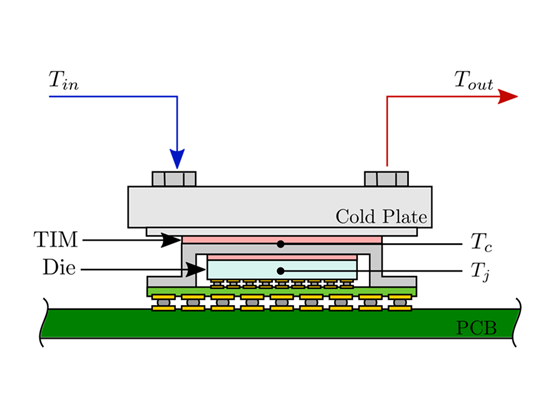
Cooling can account for up to 40% of energy usage in data centers, according to the Department of Energy.¹ As AI workloads push rack densities toward 100 kW and beyond, the decisions that determine thermal performance now extend to the molecular level.
Traditional forced-air cooling cannot keep up with modern chip heat flux densities, which now exceed 100 W/cm² in advanced processors — far beyond practical air-cooling limits.
Liquid cooling is no longer optional.
Liquid has approximately 1,000 times the cooling capacity of air, and rack densities of 60 kW or more can be achieved with warm-water liquid cooling, as validated by national laboratory research.² Modern HPC systems have already exceeded 125 kW per rack.
But not all liquids perform equally. pH, inhibitor package, base fluid selection, and water purity are primary performance variables that directly determine thermal conductivity, corrosion rates, pump efficiency, and hardware longevity.
FOUR DATA CENTER COOLANT CHEMISTRY VARIABLES TO UNDERSTAND
1. pH: The Lowest-Cost Early Warning Signal You May Be Ignoring
Untreated glycol solutions degrade over time to form organic acids that depress pH and accelerate corrosion. An uninhibited ethylene glycol solution is approximately 4.5 times more corrosive toward carbon steel than water, highlighting the importance of proper inhibitor packages.
For aluminum components, the risk is acute: the protective oxide film that passivates aluminum is stable only between approximately pH 4.0 and 8.5. Below pH 4, acidic dissolution of the passivation layer occurs, exposing the metal to rapid corrosion.
Most closed-loop data center systems should target pH 8.0–10.5, consistent with Open Compute Project guidance for glycol-based cooling systems.
Takeaway:
pH testing is inexpensive — and one of the fastest indicators of system health. Any deviation from the recommended range should trigger investigation.
2. Inhibitor Chemistry: Wrong Package, Wrong Metal, Wrong Outcome
Corrosion inhibitors passivate metal surfaces by forming protective films. They are consumed in the process and must be replenished.
Different inhibitors protect different metals:
- Phosphate for steel and aluminum
- Tolyltriazole for copper and brass
- Nitrite for iron (with compatibility limitations)
The critical failure mode is incompatibility. Mixing inhibitor chemistries from different manufacturers without laboratory verification can destabilize protection and accelerate corrosion.
Takeaway:
Inhibitor compatibility is a system-level engineering decision.
3. Chloride Contamination: Why Tap Water Is Never 'Just This Once'
Chloride ions are among the most aggressive contaminants in a cooling loop. They promote localized pitting corrosion, particularly in aluminum components.
Pitting corrosion is insidious: it is highly localized, difficult to detect visually, and can produce pinhole leaks in cold plate microchannels.
Industry guidance recommends:
- Chloride levels below 25 ppm in system fluid
- Dilution water meeting the same standard
For comparison, the U.S. EPA Secondary Drinking Water Regulation for chloride is 250 mg/L.
Tap water chloride levels vary widely by municipality and may exceed acceptable levels for cooling systems.
Takeaway:
Use deionized, demineralized, or reverse osmosis-treated water for all dilution and top-off. There is no safe exception.
4. Galvanic Corrosion: The Hidden Tax of Mixed-Metal Systems
Modern cooling loops are inherently mixed-metal: copper cold plates, aluminum heat exchangers, steel piping, brass fittings.
In a conductive electrolyte — such as glycol-water — dissimilar metals form galvanic cells. Aluminum typically acts as the anode and corrodes preferentially.
Research has documented an additional failure mode: copper ions can migrate through solution and deposit on aluminum surfaces, creating new electrochemical sites that accelerate corrosion without requiring direct metal-to-metal contact.³
Temperature is also an important factor. According to Arrhenius behavior, reaction rates often increase by approximately 2× for every 10°C increase, although the exact factor depends on system chemistry and materials.
One study found that corrosion rates of iron-carbon alloys in sulfuric acid increased by approximately 2.3× per 10°C rise.⁴
Takeaway:
A rise in coolant temperature increases corrosion rates, making thermal management and chemistry management inseparable.
A PRACTICAL MONITORING PROTOCOL: WHAT TO TEST AND WHEN
The following parameters form a baseline monitoring framework for liquid-cooled data center systems:
-
pH — Primary indicator of inhibitor reserve and acid accumulation. Maintain within recommended range (8.0–10.5).
-
Glycol concentration (refractometer) — Confirms freeze protection and detects dilution.
-
Reserve alkalinity — Quantifies remaining inhibitor buffer. Many operators use a ~50% depletion threshold as a planning trigger, depending on formulation.
-
Dissolved metals (ICP-OES) — Rising copper or aluminum indicates active corrosion.
-
Chloride content — Should remain below 25 ppm.
-
Biological activity — Relevant primarily below ~25% glycol concentration, where microbial growth becomes possible.
Testing cadence should be determined by system criticality. Annual laboratory analysis combined with periodic field monitoring form a common baseline.
CONCLUSION: CHEMISTRY IS COMPETITIVE INFRASTRUCTURE
Coolant chemistry is a major factor in determining GPU throughput, achievable PUE, infrastructure longevity, and total cost of ownership.
The failure modes — pH drift, inhibitor depletion, chloride pitting, galvanic corrosion, thermal oxidation — are well-documented in national laboratory and peer-reviewed research. They are also largely preventable.
In an era where a single AI training run can be worth millions of dollars, even minor degradation in cooling performance can have outsized consequences.
Don't think of your coolant chemistry as a cost center, because that's not what it is.
Coolant chemistry is infrastructure.
REFERENCES
- DOE Announces $40 Million for More Efficient Cooling for Data Centers. Energy.gov. (2023, May 9). https://www.energy.gov/articles/doe-announces-40-million-more-efficient-cooling-data-centers
- NLR.gov. (n.d.). High-performance computing data center warm-water liquid cooling. National Laboratory of the Rockies. https://www.nlr.gov/computational-science/warm-water-liquid-cooling
- Obispo, H.M., Murr, L.E., Arrowood, R.M. et al. Copper deposition during the corrosion of aluminum alloy 2024 in sodium chloride solutions. Journal of Materials Science 35, 3479–3495 (2000). https://doi.org/10.1023/A:1004840908494
- V. Konovalova, The effect of temperature on the corrosion rate of iron-carbon alloys, Materials Today: Proceedings, Volume 38, Part 4, 2021, Pages 1326–1329. https://doi.org/10.1016/j.matpr.2020.08.094