Like other industries, solid-liquid separation in the food and beverage industry wastewater process is a crucial task.
Food and beverage (F&B) wastewater is often high in total suspended solids/fats, oils and greases (TSS/FOG), chemical oxygen demand/biochemical oxygen demand (COD/BOD), and can be highly variable by shift/product (dairy, brewing, meat, beverages, sauces, etc.).
What that means is food and beverage operators need to be aware of their system's specific needs and tailor their treatment plan accordingly. In addition to being aware of your specific industry subsegment's needs, it's also important to be aware of updates and research in food and beverage wastewater treatment (you'll find a few of those at the end of this article).
Definition of Solid-Liquid Separation for Food and Beverage
Solid–liquid separation is the set of physical/physicochemical steps that remove suspended, floatable, and settleable solids before downstream biological polishing or discharge.
Effective solid-liquid separation in food and beverage means:- Reducing organic load to biological systems (more stability, fewer upsets)
- Cutting aeration/energy demand and sludge volume
- Helping meet limits for TSS/FOG and protects membranes/bioreactors
In general, this is the skeleton of a typical food and beverage wastewater workflow (and where solid-liquid separation fits), although some operations may have some steps in a slightly different order:
Headworks → Equalization → Primary solid–liquid separation (screens/DAF/primary clarification) → Biological treatment (aerobic/anaerobic) → tertiary polishing/disinfection (as needed)
-
Symptoms of weak Solid-liquid separation (aka watch out for these)
• Rising aeration cost
• Foaming
• Bulking sludge
• Membrane fouling
• Permit excursions
• Sludge hauling surprises
-
Food and Beverage Wastewater Treatment Techniques
Source control & segregation
-
The most cost-effective solid–liquid separation strategy often begins inside the plant rather than in the treatment system. Source control focuses on minimizing solids, fats, and product losses before they ever reach the drain. Practices such as dry cleanup prior to washdown, optimized CIP sequencing, and capturing product spills at the line can significantly reduce TSS and FOG loading. Segregating high-strength streams—like first-rinse waters, product dumps, whey, or yeast losses—allows facilities to treat concentrated waste separately or recover value where feasible.
-
Why this matters: By reducing hydraulic and organic shock loads, source control stabilizes downstream separation and biological processes while lowering chemical and energy costs.
-
Screening and Headworks
- Screening serves as the first mechanical barrier in most food and beverage wastewater systems. Coarse and fine screens—such as rotary drum, step, or static wedge-wire units—remove larger suspended solids, fibrous material, and debris before they can clog pumps or overload downstream equipment. While screening does not address dissolved or emulsified contaminants, it is essential for protecting primary separation units like DAF systems or clarifiers. Proper maintenance, bypass prevention, and odor management are critical to ensure reliable performance.
- Why this matters: Effective headworks design reduces maintenance burdens and improves overall system resilience.
-
Gravity Separation
- Gravity-based separation relies on the natural settling of heavier suspended solids. Primary clarifiers or lamella (inclined plate) clarifiers are commonly used where wastewater characteristics allow solids to settle efficiently. These systems are relatively simple and energy-efficient, making them attractive for streams with consistent flow and particle characteristics. However, they are less effective for emulsified fats, which require chemical destabilization, or very fine colloidal particles and can struggle with highly variable loads. Performance depends heavily on hydraulic design, solids loading rate, sludge withdrawal frequency, and preventing short-circuiting.
- Why this matters: When matched appropriately to wastewater characteristics, gravity separation provides a stable and economical first stage of treatment.
-
Coagulation/Flocculation with Dissolved Air Flotation (DAF)
-
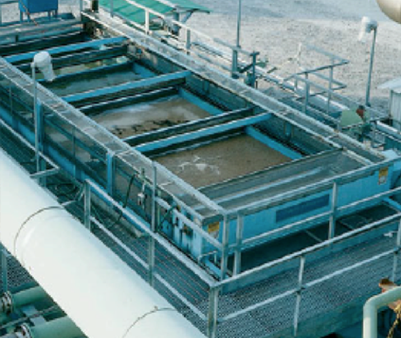
DAF systems are widely considered the workhorse of solid–liquid separation in food and beverage facilities, particularly where fats, oils, grease (FOG), proteins, and fine suspended solids are present. Chemical coagulation and flocculation aggregate small particles into larger flocs, which are then floated to the surface using microbubbles of dissolved air. The resulting floated solids are skimmed off, leaving clarified effluent. DAF is especially effective for emulsified fats and fine colloidal material that would not settle easily in gravity systems. Successful operation depends on careful control of pH, chemical dosing, air-to-solids ratio, and hydraulic loading.
-
Why this matters: When properly optimized, DAF significantly reduces TSS and FOG loading to downstream biological systems and enhances overall plant stability.
-
Centrifugation
-
Centrifugation uses rotational force to accelerate the separation of solids from liquid, making it effective for streams with higher solids concentrations or for sludge thickening and dewatering applications. Decanter centrifuges are commonly employed in food processing environments where compact footprint and rapid solids capture are desired. Although centrifuges can achieve high separation efficiency, they typically involve higher energy consumption and maintenance compared to gravity-based systems.
-
Why this matters: These are often applied strategically for sludge management or specialized side streams rather than as the primary separation method for the entire wastewater flow.
-
Membrane-Based Separation (MBR, UF, MF)
-
Membrane technologies provide a physical barrier that retains suspended solids and biomass while allowing treated water to pass through, producing high-quality effluent suitable for discharge or reuse. Membrane bioreactors (MBRs) integrate biological treatment with membrane filtration, combining degradation of organics with advanced solids separation in a compact footprint. Ultrafiltration (UF) and microfiltration (MF) systems are also used for polishing applications. While membranes offer superior effluent quality and space efficiency, they require robust upstream pretreatment to minimize fouling and maintain performance.
-
Why this matters: Energy use, cleaning protocols, and operational complexity are important considerations, but for facilities with strict discharge limits or water reuse goals, membrane-based separation can provide significant long-term benefits.
How to Optimize Your Solid-Liquid Separation Process in Your Food and Beverage Plant
Step 1: Measure Like Operations
Optimizing solid–liquid separation begins with wastewater characterization that reflects real plant conditions, not just laboratory averages. Sampling should capture production shifts, product changeovers, and CIP discharges, since these events often drive the highest hydraulic and organic spikes. Key parameters include flow, TSS, FOG, total and soluble COD, pH, and temperature. Evaluating results on a mass-loading basis (e.g., pounds per day) rather than concentration alone provides a clearer picture of how solids and organics impact equipment performance. Mass loading can be calculated by multiplying concentration (mg/L) by flow rate.
This operationally grounded data forms the foundation for proper equipment sizing and process control decisions. In other words, just like you clean your wastewater, you want clean data that reflects real-world conditions at your site.
Step 2: Build a Treatment Train That Matches Your Variability
An effective treatment plan must function as an integrated system rather than a series of isolated units. In many food and beverage facilities, performance issues stem from load variability rather than insufficient treatment capacity. Equalization plays a critical role in dampening hydraulic and organic swings before wastewater reaches primary separation. When flow and load are stabilized, DAF systems, clarifiers, and biological reactors operate more consistently and efficiently. Addressing variability upstream often resolves problems that might otherwise appear to be biological process failures.
Step 3: Tune Separation Like a Process
Primary separation systems require active optimization, not passive operation. For coagulation and dissolved air flotation systems, routine jar testing helps identify the appropriate coagulant and polymer combinations across relevant pH ranges. Ongoing monitoring of effluent turbidity or TSS, chemical cost per pound of solids removed, float thickness, and air-to-solids ratios supports consistent performance. In gravity clarification systems, maintaining proper solids loading rates, monitoring sludge blanket depth, and ensuring consistent sludge withdrawal prevent carryover and loss of efficiency. Treating separation as a controlled process reduces chemical waste, energy consumption, and downstream instability.
Step 4: Don’t Neglect Sludge Handling
Improvements in solids capture inevitably increase sludge production, which can create new bottlenecks if not properly managed. Thickening, dewatering, storage, odor control, and hauling logistics must be aligned with the enhanced separation performance. Without adequate sludge capacity, gains in upstream efficiency may simply shift operational challenges elsewhere in the plant.
Step 5: Upgrade Controls and Instrumentation
Strategic instrumentation strengthens system stability and reduces operator guesswork. Continuous monitoring of flow and pH in equalization, turbidity after primary separation, and dissolved oxygen or oxidation-reduction potential in biological stages allows for rapid response to disturbances. Establishing alarm thresholds and standardized response procedures further protects against process upsets. Together, accurate measurement, integrated system design, proactive process tuning, thoughtful sludge management, and improved controls create a robust and optimized solid–liquid separation strategy for food and beverage wastewater treatment.
- In other words, you should always be monitoring your instrumentation and evaluating adjustments or additions as needed.
-
Novel Developments in Solid-Liquid Separation for Food and Beverage
Like any industry, if you're a food and beverage wastewater treatment specialist, you should always keep up to date on developments in your field. Knowledge is power, and even being up to speed on research that might not be ready for your application just yet can have value.
Below are a few examples of some recent literature in the field:
Electrocoagulation
An October 2025 review published in the journal Desalination and Water Treatment reviews electrocoagulation versus traditional methods in food and beverage wastewater treatment (Alshrefy et al.).
As the study notes, high levels of organic matter, suspended solids, and heavy metals in food and beverage wastewater pose environmental and public health challenges.
In comparison to traditional methods, as outlined in the introduction, electrocoagulation's benefits include "simplicity, low-cost operation, environmental compatibility, and availability of easily accessible equipment," the authors write.1
Self-Forming Dynamic Membrane Bioreactor (SFD BMR)
A September 2024 paper published in the Journal of Water Process Engineering outlines a bench-scale study of the treatment of canning wastewater via a self-forming dynamic membrane bioreactor showed a link between instable filtration performance and influent water quality (Tumolo et al.).
The authors define the SFD BMR as "a biological layer formed by suction of the suspended biomass on a porous inert material represents the fine filtration medium."2
"The SFD MBR has been widely tested for treating municipal wastewater, consistently achieving very good effluent quality [4], whereas the few studies performed so far on other streams suggest that its suitability for industrial wastewater must be carefully evaluated [10,11]," the authors write. "Vergine and colleagues [12], who recently assessed the suitability of a SFD MBR for treating agro-industrial wastewaters under aerobic conditions, reported inconstant performance."
Self-Ultrasound Pre-Treatment in Dairy Wastewater
A third study focused on more sustainable treatment of dairy wastewater, particularly the treatment of dissolved air flotation (DAF) waste (Yu-Chen et al.).
-
The March 2024 study in Process Safety and Environmental Protection notes that DAF waste is a "byproduct with high lipid content separated from dairy wastewater, is disposed of by land spreading and causing environmental pollution."
- With that in mind, the authors studied the "effects of food to inoculum (F/I) ratio and ultrasound pre-treatment on the anaerobic digestion of DAF waste."
- Using ultrasound pre-treatment at various pulse intervals, the study found that long-chain fatty acids were reduced by 38%, the presence of which can hinder anaerobic digestion toward the goal of harnessing biowaste for the potential conversion to use as renewable energy (e.g., biogas).
- You can read the full study and all of its nuances for yourself, but the authors concluded: "This study demonstrates that dairy DAF waste can be an ideal substrate for biogas production via anaerobic digestion, which can be further enhanced by ultrasound pre-treatment."
One final note: a Dober case study outlined the results from the use of Dober product for wastewater treatment in a facility processing beef, pork and chicken products. The result? A 30% reduction in sludge volume versus the incumbent treatment regimen (alum plus polyDADMAC).
Interested in speaking to a Dober expert to chat about how GreenFloc products can help you with your solid-liquid separation needs?


-
References
- 1. Zinah A. Alshrefy, Zainab T. Al-Sharify, Talib A. Al-Sharify, Ali A. Abdulabbas, Ali M. Abdullah, Helen Onyeaka, Evaluating electrocoagulation and fluid flow dynamics in the treatment of food manufacturing wastewater compared to conventional methods, Desalination and Water Treatment, Volume 324, 2025, 101523, ISSN 1944-3986, https://doi.org/10.1016/j.dwt.2025.101523. (https://www.sciencedirect.com/science/article/pii/S1944398625005399)
- 2. Marina Tumolo, Carlo Salerno, Caterina Manzari, Pompilio Vergine, Marinella Marzano, Elisabetta Notario, Giovanni Berardi, Elisabetta Piancone, Graziano Pesole, Alfieri Pollice, Linking feed, biodiversity, and filtration performance in a Self-Forming Dynamic Membrane BioReactor (SFD MBR) treating canning wastewater, Journal of Water Process Engineering, Volume 66, 2024, 106031, ISSN 2214-7144, https://doi.org/10.1016/j.jwpe.2024.106031. (https://www.sciencedirect.com/science/article/pii/S2214714424012637)
- 3. Yu-Chen Liu, Sandra O’Connor, Lara M. Paulo, Camilla Maria Braguglia, Maria Cristina Gagliano, Vincent O’Flaherty, Effects of food to inoculum ratio and ultrasound pre-treatment on biogas production from dissolved air flotation waste from dairy industry, Process Safety and Environmental Protection, Volume 183, 2024, Pages 687-697, ISSN 0957-5820, https://doi.org/10.1016/j.psep.2024.01.058. (https://www.sciencedirect.com/science/article/pii/S0957582024000661)