The EPA's Multi-Sector General Permit (MSGP) for industrial stormwater expired Feb. 28, 2026. The permit meant to replace it, the proposed 2026 MSGP, has not been issued (yet).
So what does that mean for water treaters out there looking for direction?
That is an unusual position for a program covering roughly 2,200 facilities. It is also, for any operation currently wrestling with total suspended solids or chemical oxygen demand at its outfalls, the most useful planning window in five years.
Nobody likes uncertainty or feeling unprepared. Here is what actually applies right now, what the 2026 proposal tells us about where monitoring is heading, and where treatment chemistry fits in the picture.
What is the EPA MSGP?
The EPA's Multi-Sector General Permit (MSGP) authorizes stormwater discharges associated with industrial activity and sets the conditions those discharges must meet, across 29 industrial sectors. Facilities obtain coverage by submitting a Notice of Intent, then must develop a stormwater pollution prevention plan, install and maintain control measures, and conduct inspections and monitoring. Each MSGP runs five years before it is renewed.
The MSGP covers approximately 2,200 facilities in areas where the EPA is the NPDES permitting authority. Additionally, the MSGP covers a wide range of industries, including land transportation, scrap recycling, and mineral mining, among others.
On the other hand, the MSGP doesn't cover: construction stormwater discharges (except for mines), stormwater discharges from the non-industrial portions of facilities (most parking lots, office spaces, etc.), wastewater discharges, and non-point source discharges.
EPA MSGP 2021 expired: What applies to your facility today?
Now that we've set the stage, let's review what the MSGP 2021 expiration might mean for you.
The situation splits into three groups.
-
If you already had 2021 MSGP coverage, you were automatically granted an administrative continuance and you are required to keep complying with the 2021 MSGP after its expiration. Nothing about your obligations changed on March 1. Your stormwater pollution prevention plan (SWPPP), your control measures, your inspection schedule, and your benchmark monitoring all carry forward unchanged.
-
If you are a new facility that had not submitted an NOI for 2021 MSGP coverage before expiration, and began discharging on or after March 1, 2026, you cannot obtain general permit coverage until the next MSGP is issued, because there is no general permit to apply under. EPA does not have authority to extend coverage to facilities that were not already covered. Note that the trigger is the NOI, not the discharge date alone. A facility that filed before expiration and started discharging in March falls in the first group, not this one.
-
EPA's Office of Enforcement and Compliance Assurance addressed this with a No Action Assurance memorandum dated Feb. 27, 2026, exercising enforcement discretion for new operators in this gap. EPA estimated roughly 90 facilities would need it.
-
The No Action Assurance is conditional, not a waiver. To rely on it, a new facility must meet the 2021 MSGP eligibility criteria, submit a Notice of Intent form to EPA before discharging, and satisfy all applicable 2021 MSGP requirements: SWPPP development, control measure installation and maintenance, site inspections, applicable effluent limit and impaired waters and indicator and benchmark monitoring, corrective action, sector-specific requirements, and recordkeeping. Facilities also have to submit an NOI under the next MSGP within 90 days of its effective date.
-
The assurance terminates at 11:59 p.m. Eastern on Feb. 28, 2027, or 120 days after the next MSGP takes effect, whichever comes first.
-
Submitting the NOI form under the assurance does not itself constitute permit coverage. The assurance does not cover criminal violations, does not apply where circumstances may cause serious harm or present an imminent and substantial endangerment, and does not cover facilities that were already discharging before Feb. 28, 2026 without obtaining coverage. EPA also reserves the right to withdraw or revise it at any time.
-
-
If you are in a delegated state, none of the above governs you directly. EPA's MSGP applies only where EPA is the NPDES permitting authority: Massachusetts, New Hampshire, and New Mexico; Washington, D.C.; all U.S. territories except the U.S. Virgin Islands; all Indian Country lands (except in Maine); all lands of exclusive federal jurisdiction; and federal facilities in Vermont, Delaware, Colorado, and Washington. Forty-seven states and the U.S. Virgin Islands hold full or partial NPDES authorization, and in those jurisdictions your state permit controls instead.
That last point is where most readers of this article actually live, and it is the reason the federal delay still matters to you. State programs have historically used the federal MSGP as a template.
Take the Lone Star State, for example. The Texas Commission on Environmental Quality's (TCEQ) TPDES Multi-Sector General Permit expires Aug. 14, 2026, and TCEQ ran its own renewal process through 2025 on a separate track. The federal permit's content tends to migrate outward on a lag.
what's the holdup: why the msgp renewal process is delayed
EPA published the proposed 2026 MSGP for comment on Dec. 13, 2024. The comment period was extended by 90 days at stakeholder request and closed May 19, 2025, generating 90 comment letters.
EPA's own explanation for the delay is worth reading closely: the Office of Water is taking more time to re-engage with stakeholders and consider next steps given the breadth of comments, and it still has to complete Endangered Species Act consultation and Clean Water Act Section 401 certification, procedural steps EPA notes can take six months to a year on their own.
In plain English, the next MSGP is unlikely to be ready in the near future, and its final content is genuinely unsettled. EPA's own draft fact sheet instructs reviewers to read all of its text as proposed and not final. Anyone telling you exactly what the 2026 permit will require is guessing ... even so, it's still worth familiarizing yourself with the proposed changes and being ready to address them if/when they go into effect.
What the msgp proposal signals about monitoring
With that caveat firmly in place, the proposed 2026 MSGP is still the best available forecast for us to work with.
Let's break down the proposed changes that matter most to you operationally (keeping in mind that these are currently proposals, not officially approved as of this writing):
A shift from indicator to benchmark monitoring for certain sectors
This is the significant one and it gets less attention than PFAS. EPA evaluated pH, total suspended solids (TSS), and chemical oxygen demand (COD) results collected as report-only indicator monitoring under the 2021 MSGP and compared them against 2021 benchmark thresholds. For sectors where a significant number of data points would have exceeded, the proposal would shift those three parameters from indicator to benchmark monitoring, and separately add new benchmark monitoring for ammonia, nitrate, nitrite, and metals. 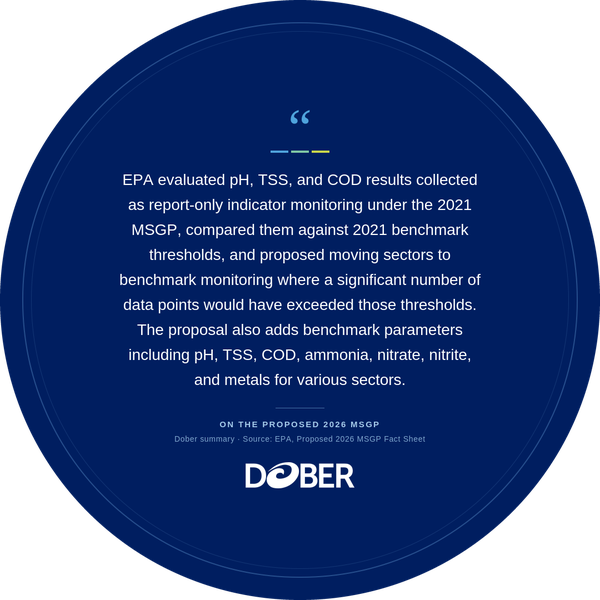
Bottom line, what does that mean? Indicator monitoring means you sample and report. Benchmark monitoring means an exceedance triggers the permit's Additional Implementation Measures (AIM) framework, a three-level structure of escalating responses. It's worth being precise here, because this is sometimes misstated: an exceedance is not itself a permit violation, provided you take the required responses within the Part 5 deadlines. What you acquire is a documented corrective action obligation on a clock.
The proposal tightens that clock. AIM Level 1 would newly require an inspection to identify the cause of the exceedance within 7 days of triggering, with findings submitted electronically. An AIM Triggering Event Report would be due within 14 days of the event, and again within 14 days of completing the corrective action. Facilities that have spent five years reporting elevated TSS or COD as report-only data would acquire all of it.
EPA identified 11 subsectors for this shift, selected because their 2021 MSGP indicator monitoring produced a significant number of data points that would have exceeded the applicable benchmark. These are subsectors, not whole sectors, so check your specific code rather than assuming your entire sector is affected:
- E3 Glass and Stone Products
- I1 Oil and Gas Extraction
- L2 Landfills
- N2 Source-separated Recycling Facilities
- O1 Steam Electric Generating Facilities
- P1 Land Transportation and Warehousing
- R1 Ship and Boat Building and Repairing Yards
- U3 Meat and Dairy Products
- Y2 Misc. Plastics
- AB1 Transportation Equipment, Commercial Machinery
- AD1 Non-Classified Facilities (designated by director)
In other words, you've really got to be on your water treatment game with additional benchmark monitoring responsibilities.
Quarterly report-only PFAS indicator monitoring
The proposal would require 23 of the permit's sectors to conduct quarterly indicator monitoring for PFAS using EPA Method 1633. Two things we want to highlight on this point:
First, it is report-only. EPA's fact sheet explains there is no benchmark threshold or baseline for comparison and no follow-up corrective action required under Part 5 if PFAS is detected. But report-only is not the same as consequence-free. EPA also states that the Part 2.2 requirement to comply with applicable water quality standards still applies to any pollutant monitored under the permit.
Second, EPA is explicit that the purpose is baseline data collection that may inform later consideration of PFAS benchmarks. It is a census, not a limit. The compliance cost is analytical and administrative, and the strategic risk is what EPA does with the resulting dataset.
Expanded impaired waters monitoring
Under the 2021 MSGP, operators discharging to impaired waters without an approved TMDL monitored in the first and fourth years of coverage. The proposal would require quarterly monitoring for the entire permit term, for discharges to impaired waters with or without a TMDL.
It also adds a corrective action trigger where none existed. If monitoring detects the pollutant of concern in the discharge, or a parameter falls outside the acceptable range for the waterbody to meet its designated use, the operator would have to comply with AIM Level 1 responses and take all reasonable steps to prevent the discharge. For a facility discharging solids or metals to a water impaired for those pollutants, this is a larger practical change than the PFAS provision.
Tighter language on visible contamination
The proposal sharpens Part 2.2 so that a discharge must not contain or result in observed deposits of floating, settled, or suspended solids, scum, sheen, or substances; an observable film or sheen upon or discoloration from oil and grease; an observable foam; or substances that produce an observable change in color or odor.
For facilities where an oily sheen on a retention basin is an occasional nuisance rather than a tracked parameter, this converts a housekeeping issue into a permit condition. Once again, it means leveling up your practices.
Where treatment chemistry fits, and where it doesn't
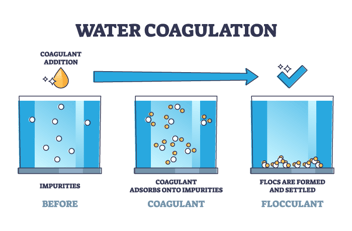
Most MSGP compliance is not chemical treatment. It is source control: covering material storage, sweeping, containment, spill response, run-on diversion, good housekeeping, and the SWPPP discipline that documents all of it. If your TSS numbers are driven by an uncovered aggregate pile, a coagulant will not fix that and no one should suggest otherwise. Eliminate the source first. It is cheaper and it is what an inspector will ask about.
Coagulation and flocculation become relevant in a narrower set of situations:
- Stormwater collected in a basin or tank that is treated before batch discharge, where solids and turbidity have to be knocked down to hit a numeric limit
- Facilities using polymers or other chemical treatment for erosion and sediment control, which Part 2.1.2.5 requires be identified by name and purpose in the SWPPP
- Sites where the current treatment program is not allowing the system to reach maximum efficiency
- Dewatering of accumulated basin sediment, where the solids have to be separated and the return water has to meet the same limits as the discharge
If any of those describe your site, the proposed benchmark changes for TSS, COD, and metals are aimed squarely at parameters that respond to coagulant selection and dose optimization. And PFAS is not on that list. Coagulation is not a PFAS treatment, and any solids-based process that did capture PFAS would concentrate it into the sludge rather than destroy it, which trades one management problem for another.
Six things water treaters should consider before the next msgp takes effect
- Pull your last five years of indicator monitoring data and compare it to the 2021 benchmark thresholds for your sector. This is the single most informative hour you can spend. If your TSS or COD numbers would have exceeded, you have advance notice of a problem the proposal is designed to catch.
- Check whether you discharge to an impaired water, and for which pollutants. The proposed shift to quarterly monitoring for the full term, with detection triggering corrective action, is easy to miss and expensive to discover late.
- Confirm your permitting authority. If you are in a delegated state, watch your state's renewal calendar rather than EPA's.
- If you are a new facility relying on the No Action Assurance, calendar both end dates. Feb. 28, 2027 and 120 days after the next MSGP's effective date, whichever arrives first. Missing the follow-on NOI window forfeits the protection.
- Separate your source-control fixes from your treatment questions. Do the housekeeping work now. It is lower cost, it stands on its own, and it tells you what residual load actually requires chemistry.
- If a residual load remains, characterize it before you specify a solution. Jar testing on your actual water, across the seasonal range, is how you find out whether the problem is dose, coagulant chemistry, mixing energy, or retention time.
How Dober can help
GreenFloc® natural coagulants and demulsifiers are bio-based biopolymers developed for solids removal, oil and water separation, and heavy metals reduction across automotive, metals, oil and gas, mining, food and beverage, and centralized waste treatment operations. For facilities weighing them against traditional synthetic polymers such as polyDADMAC and polyamines, the comparison worth running is on your own water: performance at dose, resulting sludge volume and handling characteristics, and the documentation obligations that come with each.
If you are working through what your outfall data means, our jar testing guide walks through the protocol, and our team can run comparative testing on your water. Understanding the load comes first. The chemistry decision follows from it.