A healthy soil is teeming with life…and not just with the crops we are growing. In the subterranean microscopic world of our soil, numerous species of actinomycetes, bacteria, fungi, nematodes, and protozoa perform a complex, integrated, choreographed, biochemical symphony. Together, these organisms bolster soil health, nitrogen fixation, nutrient cycling, plant signaling, stress mitigation, and ultimately plant health.
While their nefarious cousins wreak havoc by causing diseases and crop losses and grab most of the attention of agronomists (rightfully so), a true understanding of crop production cannot be complete without gaining a general knowledge of what microbes are beneficial, what they do, and why it matters.
The Soil’s “All Star” Team
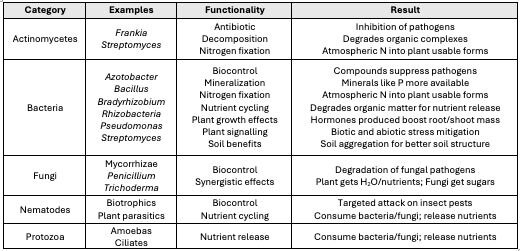
A systematic review of a “Soils 101” textbook or a quick internet dive goes a long way in establishing which beneficial microbes are the most common, and what they contribute. The following chart summarizes these findings:
These naturally occurring microbes can only produce the desired results if they are allowed to thrive. It’s critical they receive the nutrients and water necessary to sustain themselves, and any input that enhances the soil environment will contribute to their performance.
New Kids on the Block
In recent years, the idea of introducing specific and sometimes gene-edited microbes into the environment has gained a following, especially around their use for converting atmospheric N into plant-usable forms in non-leguminous crops like corn. These have become commonplace in the market and have been used successfully on millions of crop acres. Other examples are microbes to alleviate stress and offer biostimulant properties.
The most important thing to remember here is that what is good to allow naturally occurring microbes to thrive is also very applicable to these introduced microbes. What is good for one subset is just as good for the other.
Soltellus™: The Best Friend a Microbe Ever Had
Soltellus™ is a biodegradable polymer that can amplify the effectiveness of biological products and applied microbes in the soil when applied in tandem. It also aids the naturally occurring microbes listed above to thrive and function optimally. It does this through specific modes of action, as follows:
-
- Free aspartic acid in the Soltellus™ formulation jump-starts the microbes as a food source and reduces stresses while the populations become established
- Soltellus™ chelates and supplies key nutrients to plants and microbes that they need for maximal growth and development via anionic attraction of cations and ion-bridging mechanisms
- The hygroscopic effects of the polymer retain moisture in the root zone and alleviate stress factors
- The polymer structure facilitates better contact of the microbes with root systems and soil needed for optimal colonization and desired efficacy
- Improved plant health increases root exudation to foster a better environment for the microbes
- Microbes ultimately degrade Soltellus™ to its C and N subunits and release all chelated nutrients to serve as additional microbial food sources
- Soltellus™ reduces the use and reliance on chemical fertilizers that promote the use of biological alternatives that are more sustainable
Field Data Proves Performance Synergy
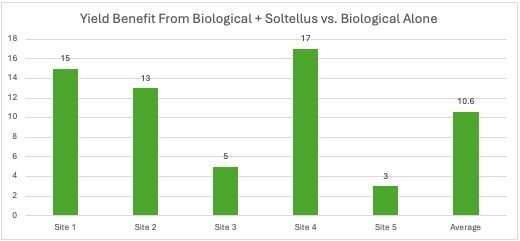
In 2024, a series of five trials was conducted in SW Minnesota using Soltellus™ in tandem with a biological crop nutrition product and compared to the biological product alone. Soltellus™ boosted yield in 100% of the trials by an average of 10.6 bu/A over the biological product by itself.
To learn more about Soltellus™, download our free agronomy eBook, or contact a member of our Dober Agronomy Sales team. Also be on the lookout for our regular webinar sessions that highlight Soltellus™ as an important tool for crop production.