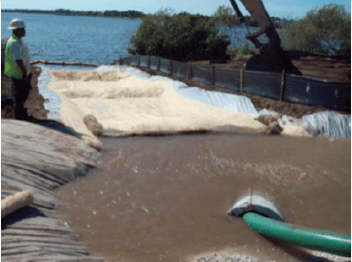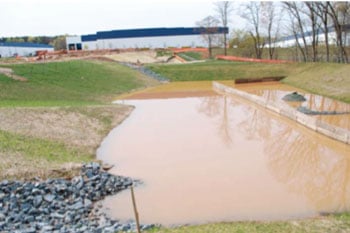
Two water treatment contractors can be treating nearly identical muddy water and arrive at completely different setups.
At every water treatment operation, there are three imaginary doors, each marked with a water treatment delivery method: passive, semi-passive or active.
Which door do you choose?
In the example of the two contractors, one might drop a dry flocculant sock into a channel and walk away. The other, meanwhile, runs a trailer-mounted system with pumps, tanks, and real-time turbidity meters.
Neither option is wrong. They picked different points on the same spectrum, and the right point depends on the water, the site, and the permit.
That spectrum runs from passive to active, with a practical middle ground often called semi-passive.
Understanding where your project sits is the difference between over-building an expensive system you did not need and under-treating water that then blows past your discharge limit.
A quick note on chemistry first: all three approaches can run on the same core treatment chemistry. HaloKlear® natural flocculants are chitosan-based, a sea-based biopolymer that carries a positive charge and neutralizes the negative surface charge on suspended clay and silt so those particles clump into settleable flocs (Bhalkaran & Wilson, 2016).
What changes across passive, semi-passive, and active is not usually the chemistry. It is how you deliver, mix, and control it.
The three Water Treatment approaches, defined
Passive treatment applies a flocculant to reduce turbidity through coagulation and flocculation without relying on computerized, enclosed systems with pumps, filters, and real-time controls. In regulatory terms it is the application of natural or synthetic products, including liquid chemicals, powders, and slow-releasing solid blocks or socks, to treat water without an active treatment system (California State Water Resources Control Board, 2022). In practice, passive treatment often means placing a solid or dry flocculant directly in the flow, on a check dam, in a channel, or in a slope drain ahead of a sediment basin, and letting the turbulence of the moving water do the mixing (Kang & McLaughlin, 2016). No external energy required.
On the opposite end of the spectrum is active treatment, which is an engineered system. An active treatment system (ATS) uses a coagulant to treat water in combination with a sedimentation basin or basins to drive turbidity reduction, and it may add pH adjustment plus bag, cartridge, or sand filtration. The exact configuration and sizing depend on the anticipated quantity and quality of the water and the receiving water requirements (California Department of Transportation, 2017). An ATS typically involves pumps, mixing, dosing controls, and monitoring.
Lastly, semi-passive treatment sits between the two. It usually means metering a liquid flocculant into the flow at a rate paced to the water, without building out the full enclosed, computer-controlled ATS train with sedimentation and filtration. You get more dosing control than a static sock and less capital and oversight than a full ATS. The term is used less rigidly than the other two in regulation, so it is worth confirming how your permitting authority classifies a given setup. (Learn more about semi-passive treatment in our case study on a construction site in Florida.)
The research bears out the headline point: both active and passive flocculant treatments can be very effective at reducing turbidity for pumped construction water. In one field study, a geotextile dewatering bag alone reduced turbidity by about 70 percent, but adding flocculant ahead of the bag pushed turbidity reduction up to roughly 97 percent relative to the influent (Kang & McLaughlin, 2016).
The approach you choose is less about whether it can work and more about matching effort and cost to your conditions. As we always say, every site is different, and you have to map out your needs when determining a right-fit course of action.
Side-by-side comparison of passive vs. semi-passive vs. active
| Consideration | Passive | Semi-Passive | Active (ATS) |
|---|---|---|---|
| How it works | Solid or dry flocculant placed in the flow; water turbulence mixes it | Liquid flocculant metered into flow, paced to conditions | Engineered system: pump, dose, mix, settle, often filter, with monitoring |
| Power and equipment | None to minimal | Modest: dosing hardware, sometimes a pump | Significant: pumps, tanks, controls, filtration |
| Setup and operating cost | Lowest | Moderate | Highest |
| Flow and TSS range | Lower, steadier flows and moderate solids | Moderate to higher flows and solids | High or highly variable flows, heavy or difficult solids |
| Turbidity control precision | Good when placed and managed well | Better; dose responds to flow | Highest and most consistent |
| Labor and monitoring | Low, but check after storm events | Moderate | High; often needs a trained operator |
| Typical HaloKlear fit | GelFloc Sock (dry chitosan concentrate) | LiquiFloc liquid systems, dosed to flow | LiquiFloc plus the Dual Polymer System (DPS) integrated into an ATS |
How to choose: the factors that actually decide it
Rather than starting from a product, start from the water and the site. A few questions usually settle, no pun intended, the choice.
How much water, and how variable is the flow? Steady, moderate flows in a defined channel are friendly to passive treatment. Large volumes, flashy storm-driven surges, or highly variable dewatering rates push you toward semi-passive dosing that tracks the flow, or a full ATS that can be sized and controlled for the load.
How high and how difficult is the solids load? Moderate suspended solids in a clay or silt matrix are well suited to passive or semi-passive treatment. Very high TSS, fine colloidal fractions that resist settling, or complications like light oils or metals point toward liquid systems and often a dual-polymer, active configuration. HaloKlear's product line reflects this: the LiquiFloc chitosan coagulant/flocculants and BHR-P50 are aimed at high-TSS systems, with BHR-P50 also addressing light oils and heavy metals.
How strict is your discharge limit? The tighter the number, the more control you want. Many sites operate under NPDES permits with turbidity and TSS limits. Under the U.S. EPA's 2022 Construction General Permit, for example, operators discharging dewatering water to sensitive waters must compare a weekly average turbidity against a 50 NTU benchmark and take corrective action above it (U.S. Environmental Protection Agency, 2022). State and MS4 limits are sometimes stricter. When you have little margin for error, the consistency of a semi-passive or active setup earns its cost.
How much space, power, and staff do you have? A remote site with no power and minimal staffing favors passive treatment. A staffed site with room for tanks and a settling basin can support an ATS. Semi-passive is often the answer when you need better dosing but cannot justify the full build-out.
How long is the project, and how much will conditions change? Short-duration, stable jobs reward simple passive setups. Long projects that move through phases, or sites where influent character shifts, benefit from the adjustability of dosed systems.
What does your permit actually allow? This one is easy to overlook. Approvals for which products and chemistries may be used, and whether they can be applied passively or only within an active system, vary by jurisdiction and receiving water. Confirm that your specific product is approved for your specific application before you commit to an approach.
Where HaloKlear fits at each tier
The advantage of a single-source chitosan chemistry is that you are not locked into one delivery method. As your site conditions change, the chemistry can move with you.
- Passive: The GelFloc Sock is a dry chitosan concentrate designed specifically for passive treatment and low-infrastructure sites. It drops into flowing water with no pumps or power, which makes it a natural fit for channels, check dams, and remote dewatering.
- Semi-passive: LiquiFloc 1% and 2% liquid chitosan coagulant/flocculants can be metered into the flow and paced to conditions, giving you dosing control without a full ATS. Per HaloKlear, GelFloc socks and LiquiFloc systems can both be integrated into passive and semi-passive treatment trains with minimal equipment.
- Active: For high or difficult loads, LiquiFloc paired with the Dual Polymer System (DPS) provides a two-step approach that forms dense, high-shear-strength flocs that settle quickly, and it integrates into an engineered active treatment system.
Across all three, HaloKlear's core differentiators travel with the chemistry: the products are acrylamide-free, recognized as a Best Management Practice, and formulated to perform at dosages that are typically about 30 percent lower than competing products, which reduces both chemical cost and disposal volume.
Regardless of delivery method, residual test kits let you verify treatment performance and confirm discharge levels in the field rather than waiting on an off-site lab.
Common mistakes when choosing an approach
- Over-building for a simple site. A full ATS on a low-flow, moderate-solids channel is money and labor spent on control you do not need. Match the tool to the water.
- Under-treating a hard site. The reverse is worse. A passive sock on flashy, high-TSS flow can leave you exceeding your limit with no easy way to respond. When the load is heavy or variable, plan for dosing control.
- Placing passive treatment with too little mixing or contact. Passive systems rely on turbulence and travel distance to mix and react. Install in flowing water upstream of your sediment control, not at a still perimeter, and give the flocs distance and time to form and settle (Kang & McLaughlin, 2016).
- Skipping the treatability step. The fastest way to pick the wrong approach is to guess at how your specific soil and water will respond. A jar test tells you the dose and chemistry; site conditions tell you the delivery method. Do both before you build.
- Assuming the permit will allow your plan. Confirm product and method approval for your jurisdiction and receiving water up front, not after mobilization.
Start with a test, not a guess
Choosing among passive, semi-passive, and active is ultimately a site decision, but it rests on a chemistry decision you can make on the bench. A jar test identifies the right chitosan chemistry and dose for your water (see our companion guide on running a jar test and dialing in dose), and from there the flow, solids, space, and permit factors above point you to the delivery method.
So, when you ultimately go to walk through one of those three doors we mentioned in the intro, you should be able to walk through with confidence that you're making the right choice.
If you would rather not sort it out alone, HaloKlear provides on-site and off-site treatability testing to match chemistry, dose, and approach to your conditions and help document compliance before you discharge. Choosing the right approach is how you avoid paying for control you do not need, or missing control you do.
Download our water treatment product catalog to learn more about which products and application methods might be most suitable for you site.