Scale Buildup: The Silent Killer of Irrigation System Efficiency
Today’s farmer has many challenges and obstacles to avoid and overcome. Admittedly, irrigation system efficiency is probably not at the top of the list. But ignoring an issue like scale buildup in irrigation lines can lead to costly unintended consequences. Let’s investigate what scale is and how it forms, focus attention on the problems it poses, and highlight some preventative measures, including using Soltellus™.
We have all heard the term “hard water.” By definition, hard water is water containing a large concentration of dissolved minerals like calcium and magnesium carbonates. The bedrock under a lot of agricultural land is limestone, which contributes these minerals into the water flowing through this foundation.
In fact, a whopping 85% of the US has hard water, with the Midwest, Southwest, and Florida having the biggest issues.1 These minerals, along with dissolved iron, precipitate out, depositing in the irrigation systems and accumulating over time to form the scale buildup. This problem intensifies if the irrigation water typically is applied with water-soluble, phosphorus-rich fertilizers.
A Problem of Scale
As scale builds, it adversely affects irrigation system performance by:
-
- Clogging emitters
- Reducing water flow rate
- Increasing energy costs thus decreasing system efficiency
- Causing inconsistent watering (patterns and amount)
- Increasing down time and costs for system maintenance
- Instigating eventual equipment failures
These effects not only cause direct economic hardships for the grower, but lead to issues for the crops grown under these irrigation systems. Under-application of water and fertilizers directly reduce crop health, growth rates, and yield performance. An economic “double whammy.”
Best Management Practices
The following are typically touted as best practices for managing scale:
Proactive
-
- Water softening/pretreatment
- Regular system flushing
- Commercial scale filtration systems
- Water treatment chemicals
Reactive
-
- Acid injections
- Cleaning agents (especially enzymes)
While these can be effective practices, they might not be feasible or economical for all irrigation operations.
Bring Soltellus™ in the Mix
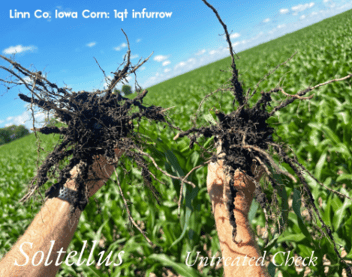
Soltellus™ is built on an anionic polymer chassis recognized for its unique nutrient chelating properties. While it is known to attract, hold and supply key nutrients in the root zone when applied with or in relation to fertilizer (i.e. a “hub of nutrient ion exchange”), it can also help deter scale buildup by chelating the cationic calcium, magnesium and iron as it is injected and moves through the irrigation lines, tying up the very nutrient ions that cause scale in the first place.
And, once the treated water exits the irrigation system, the crop benefits agronomically from those released nutrients, optimal watering, and a stimulated soil microbiome.
Contact us to learn more details about Soltellus™, and be sure to download our free agronomy guide for more info on enhancing crop performance with agronomic, economic, and sustainability benefits in mind.
Sources:
1. A Look at Hard Water Across the US, Home Water 101 The Marmon Group